How To Care For Sourdough Starter
You either made or were gifted a sourdough starter. So what do you do now? Care for your sourdough starter and begin making bread, of course! While it can feel overwhelming at first, the key to sourdough is simply finding a process that works for your lifestyle and amount of bread baking. Learning how to care for your sourdough starter is simple. Once you experiment and find a routine that works, you will have gained an amazing skill that sets you up for a lifetime of baking delicious breads.
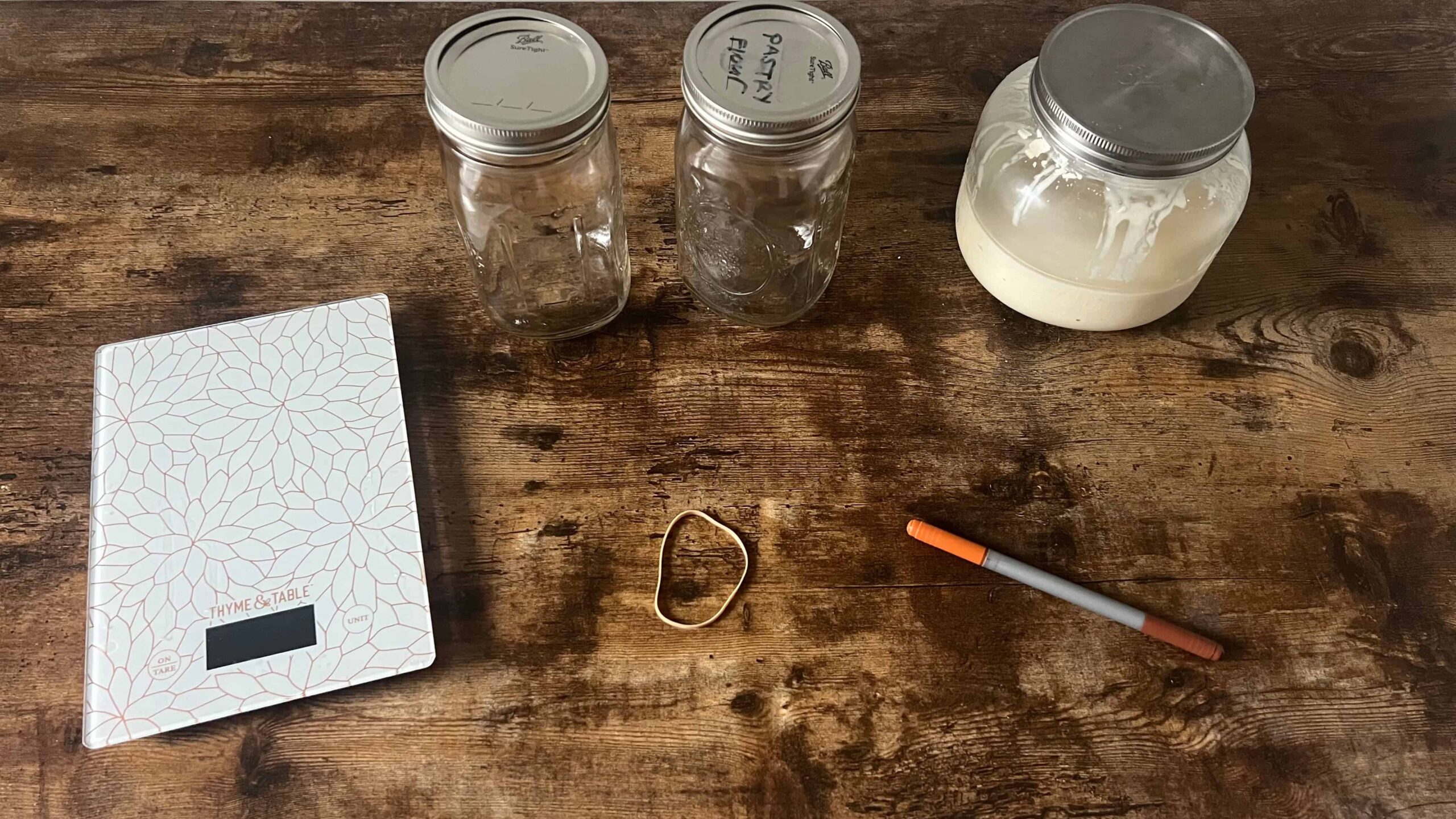
Recommended Tools
Two wide mouthed Ball or Mason jars: Keep starter in one jar and transfer to the other when it is time to clean the jar to prevent mold.
One quart or half gallon Mason jar: You can collect discard in this larger jar and store in the refrigerator for discard recipes.
Kitchen scale: Using a kitchen scale to measure in grams allows for better accuracy.
Rubber band or washable marker: Have a way of marking the height of your starter right after feeding to know when it has doubled in size.
The Basics-How To Care For Your Sourdough Starter
Sourdough boils down to three basic factors- 1) where to store your starter, 2) how to feed your starter, and 3) how to bake bread with your starter.
1) Where To Store Your Starter
Generally speaking, bread requires yeast in order to be made, and sourdough is just the natural version of the packaged yeast you can purchase at the grocery store. A starter is a collection of “wild” yeast that was caught from the air and stabilized in a container. As a living organism, the yeast needs food (flour), water, and oxygen to survive.
Countertop vs Refrigerator
Depending on the frequency of your breadmaking, you can either leave your starter on your kitchen counter at room temperature (for more frequent use) or in the refrigerator (for less use).
Leave your starter on the kitchen counter at room temperature if you plan to bake two times or more a week. A room temperature starter likes to be fed every 1-3 days. This will help keep it easily activated and make your sourdough less “sour” tasting.
Leave your starter in the refrigerator if you plan to only bake once a week (or less). The lower temperature causes the starter to enter a ‘dormant’ state and can last several months in the refrigerator. Over time a dark liquid called hooch will form on top. This is the starter’s way of creating a ‘blanket’ to protect itself from the cold temperature. When you are ready to use the starter, simply drain off the hooch. Starters can remain in the refrigerator for a long time but I would recommend trying to use it or feed it every few months.
2) How To Feed Your Starter
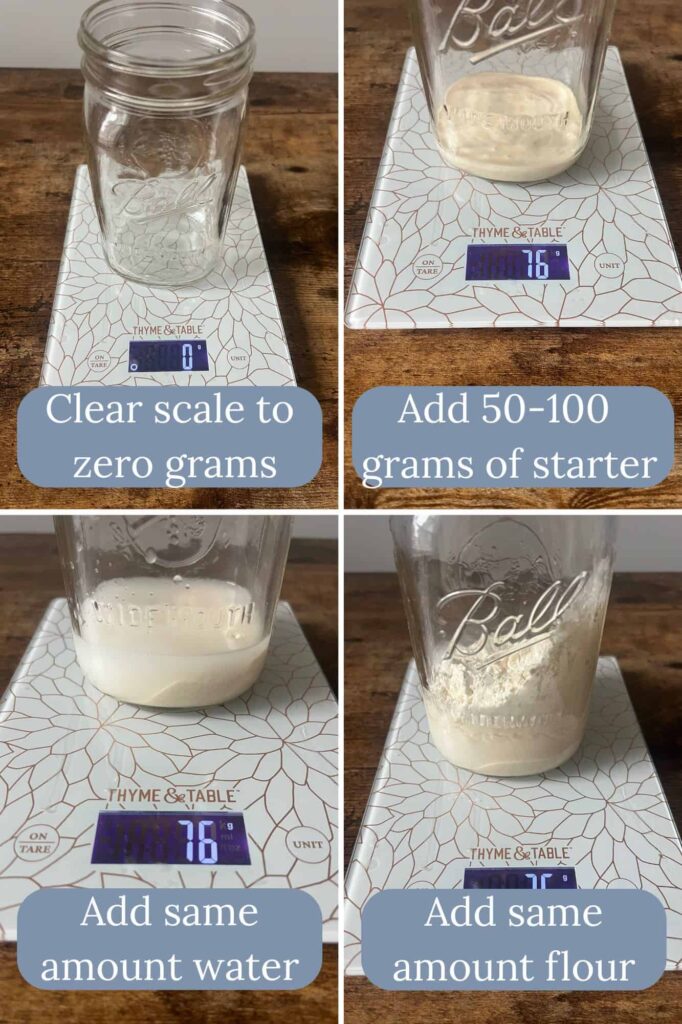
Feeding your starter means maintaining a 1:1:1 ratio of all purpose flour, water, and old starter within a container. As you feed your starter (adding flour and water) you will be growing your available starter by 3 times the amount. Depending on how much you want to bake you can control how little or how much starter you keep on hand.
It is best to use a kitchen scale and measure your ingredients in grams to allow for more accuracy. You can measure in cups if you want but your starter might not be the same consistency every time.
Tip: I have found that if you measure out your old starter first, add the water, and then add the flour, it allows you to remove ingredients if you accidentally add too much.
Example Ratio Amounts:
5 grams starter + 5 grams water + 5 grams all purpose flour = 15 grams of “activated” starter
15 g starter + 15 g water + 15 g all purpose flour = 45 g of “activated” starter
30 g starter + 30 g water + 30 g all purpose flour = 90 g of “activated” starter
3: How To Bake Bread With Your Starter
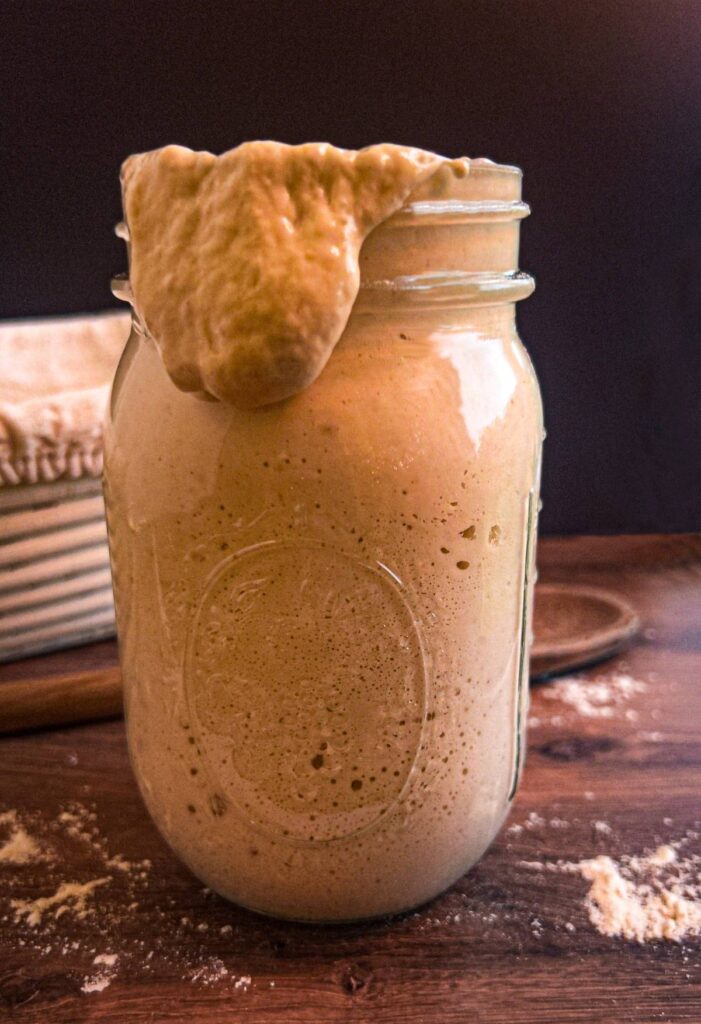
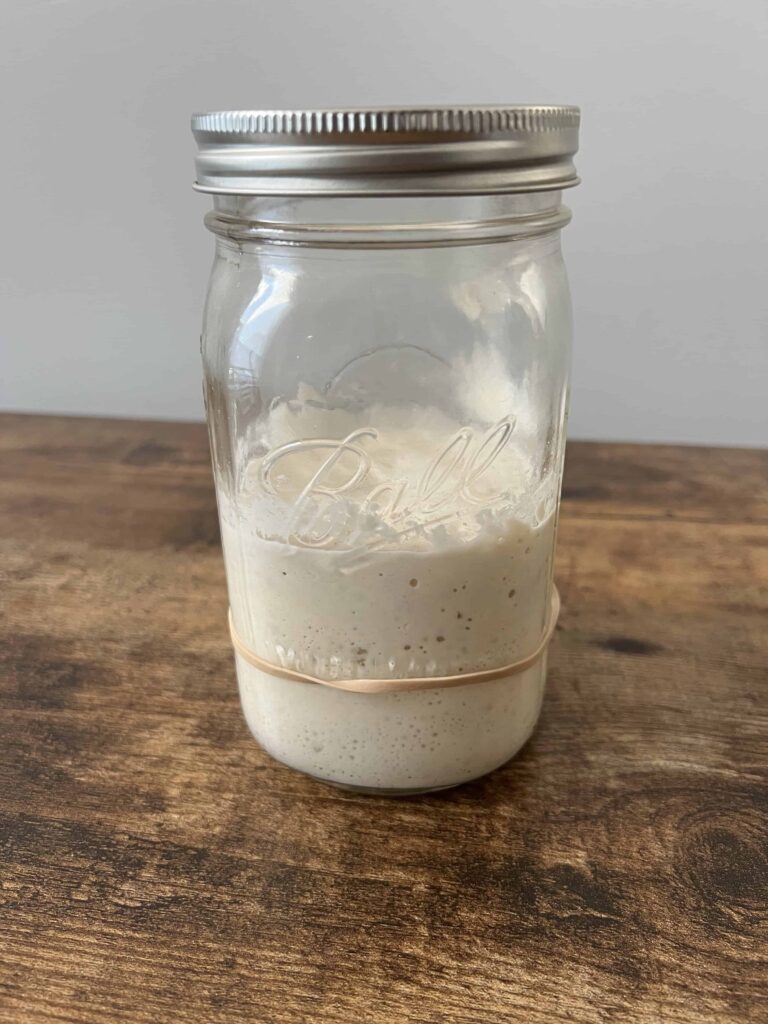
Feeding your starter will begin to ‘activate’ your starter. The old yeast will eat the newly added flour and release carbon dioxide. Your starter will bubble, rise, and eventually double in size (or more) within its container. (In order to track the starter’s growth, you can wrap a rubber band around your container or mark with a washable marker.) When the starter has doubled in size, you have an “activated” starter that is called for when making bread. Once you have removed the amount that your bread recipe calls for, you can simply repeat the process of feeding your starter to build it back up again.
FAQ
Should I use filtered water? Filtered water is recommended but tap water works too.
Can I use bread flour to feed my starter? DO NOT use bread flour or wheat flour to feed your starter. The gluten amount is too high and can make your starter dense instead of bubbly.
What is discard? Discard and sourdough starter are the same thing. Starter is called discard when it is removed from the original container so that you don’t have to feed a large amount of starter. Example: If you had 200 grams of starter, you would end up with 600 grams of starter after feeding. Unless you own a bakery, you don’t need that much starter at one time. It would make more sense to only feed 50 grams, which would mean you have 150 grams of unfed starter (which is then called discard). You CAN use discard to make tons of yummy treats! Think cookies, cakes, muffins, pancakes etc.
Helpful Tips
Don’t completely close the lid on your starter. This allows for slight air flow and for gasses to release.
While you can feed a cold starter that was taken out of the refrigerator, it is recommended that you allow it to come to room temperature first.
If your house is colder than 68 degrees (think wintertime) you can warm up your starter by keeping it in the oven with the oven LIGHT turned on.
Be sure to know how much activated starter you need for a recipe before you feed your starter. You can use inactive sourdough starter in some recipes! These are simply called discard recipes and add a delicious tang to other baked treats.

This was amazing!